

As a former public defender, my clients often faced an impossible choice: plead guilty to a crime they knew they didn’t commit or one I believed the prosecution couldn’t prove or go to trial and fight it. To the uninitiated, the answer might seem obvious. But that couldn’t be more wrong.
Take the case of seventeen-year-old George Alvarez. Mr. Alvarez was accused of assaulting a Texas corrections officer. Four years later, in an unrelated case, it came to light that the government had in its possession a video exonerating Alvarez, conclusively showing that the officer had actually attacked him. With a ten-year mandatory minimum looming over his head, Alvarez pleaded guilty. After nearly four years confined to a cage, he was finally exonerated.
According to the US Supreme Court, “[p]lea bargaining is not some adjunct to the criminal justice system; it is the criminal justice system.” Prosecutors, particularly at the federal level, have a plethora of tools at their disposal to coerce defendants into pleading guilty. In Florida, federal prosecutors have threatened an excited soccer fan with a seven-year mandatory sentence for lighting two flares at a game, causing minimal damage.
Federal prosecutors are the most powerful—and least accountable—actors in our criminal justice system. And the unwavering ability of federal prosecutors to coerce guilty pleas is a salient contributor to sheer injustice.
Shortly after President Trump assumed office, Acting Deputy Attorney General Emil Bove circulated a memorandum containing a standard directive: that federal prosecutors “[p]ursue the most serious, readily provable offense.” There is no plausible rationale to mandate that federal prosecutors always charge the most serious provable offense beyond strengthening their hands to induce guilty pleas—a skill that federal prosecutors have proven themselves incredibly adept at given that 98.3 percent of all convictions in the federal system result from guilty pleas.
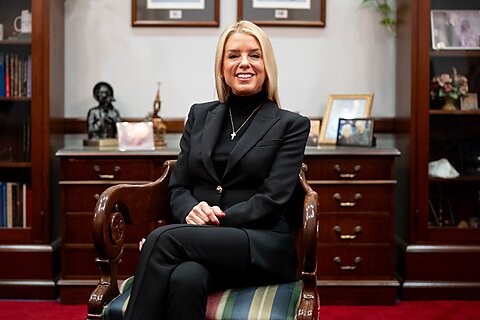
Last week, immediately after being sworn in, Attorney General Pam Bondi issued a memorandum of her own. While Bondi reiterated Bove’s standing directive to always charge “the most serious, readily provable offense”—there may be a glimmer of hope. Bondi stressed that “prosecutors may not use criminal charges to exert leverage to induce a guilty plea.” Additionally, Bondi stressed that “prosecutors may not abandon pending charges to achieve a plea bargain that is inconsistent with the prosecutor’s assessment of the seriousness of the defendant’s conduct at the time the charges were filed.”
Prosecutors’ charging decisions set the parameters for subsequent plea negotiations that are often palpably coercive. Federal crimes can carry mandatory minimums, and habitual offender laws dramatically increase a defendant’s exposure. Likewise, federal statutes such as the Armed Career Criminal Act provide for sentence enhancements for “crimes of violence” or “serious drug offenses” committed with a firearm. These types of laws are designed to tie judges’ hands—a reality that prosecutors know and take full advantage of.
An official policy of always charging the “most serious, readily provable offense” ensures prosecutors will remain free to threaten defendants with draconian, inflexible sentences if they presume to exercise their Sixth Amendment right to a jury trial.
Plea bargaining was entirely unknown at the founding. The Framers understood the potential for abuse when a single player wields unchecked power. So they carefully devised a framework where a jury comprised of ordinary citizens could pass judgment on the legitimacy, fairness, and wisdom of a given prosecution. Today, prosecutors are permitted to do just about anything short of physical torture to exert plea leverage and deter a defendant from going to trial. Prosecutors can seek a superseding indictment, charging a defendant as a habitual offender, or tack on additional charges to punish them for refusing to plead guilty. Prosecutors can threaten to indict the defendant’s family members. Prosecutors can threaten the accused with a life sentence—or even the death penalty—simply for exercising a right that the Constitution confers upon them.

Attorney General Bondi’s charging and plea-bargaining directives are difficult to reconcile. Continuing a longstanding policy commonly used to facilitate plea-driven mass adjudication contradicts her directive to not use charging decisions as leverage to induce guilty pleas. Furthermore, it is unclear whether the prohibition on abandoning charges may lead the Justice Department to always stand by the highest charge. For example, absent significant mitigating or intervening circumstances, it will rarely be appropriate for a prosecutor to seek racketeering or terrorism charges at the outset of a case and then abandon those charges in connection with a plea deal.
This could cut both ways—discouraging prosecutors from stepping back from serious charges once filed. But it’s possible that taken together, these directives may discourage prosecutors from overcharging at the onset with offenses that aren’t “[r]eadily provable”—and that could make a meaningful difference.