
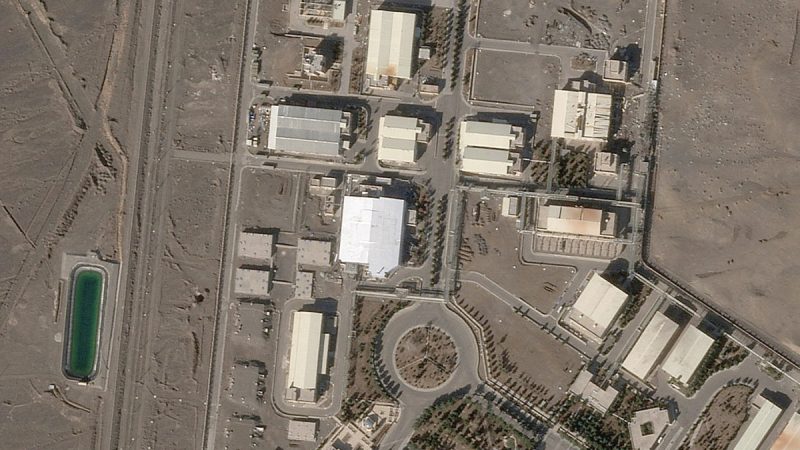
When War Secretary Pete Hegseth was asked recently whether U.S. forces would ever move to secure enriched uranium reportedly stored at Iran’s Isfahan nuclear complex, he declined to say, citing operational security.
The exchange highlighted a question the U.S. and Israel’s air campaign alone cannot answer: even if U.S. strikes degrade Iran’s nuclear infrastructure, who would physically secure the enriched uranium, and how?
Iran is believed to possess a significant stockpile of uranium enriched to 60%, near weapons-grade. That material could theoretically be used in multiple nuclear devices if further refined.
Moving from 60% to weapons-grade 90% enrichment requires additional processing, and weaponization would involve further technical steps. But analysts say the more immediate issue is physical control of the material itself.
‘If the U.S. wants to secure Iran’s nuclear materials, it’s going to require a massive ground operation,’ Kelsey Davenport, director of nonproliferation policy at the Arms Control Association, told Fox News Digital.
Davenport said the highly enriched uranium believed to be stored at Isfahan appears to be deeply buried and contained in relatively mobile canisters. Securing it would likely require locating the full stockpile, accessing underground facilities and safely extracting or downblending the material.
‘It’s not even clear the United States knows where all of the uranium is,’ she said, noting that the mobility of storage containers raises the possibility that some material could be moved or dispersed.
The administration repeatedly has said preventing Iran from obtaining a nuclear weapon remains a central objective of Operation Epic Fury.
‘Ultimately, this issue of Iran’s nuclear pursuit and their unwillingness through negotiations to stop it is something President Trump has said for a long time needs to be dealt with,’ Hegseth said.
Senior administration officials have argued that Iran sought to build up its ballistic missile arsenal in part to create a deterrent shield — enabling Iran to continue advancing its nuclear program while discouraging outside intervention.
So far, however, the bulk of U.S. strikes have focused on degrading missile launchers, air defenses and other conventional military targets.
Experts note that dismantling missile systems may reduce Iran’s ability to shield a potential nuclear breakout. But physically controlling enriched uranium itself presents a separate and more complex challenge.
Airstrikes versus physical control
Defense officials have acknowledged that degrading nuclear infrastructure from the air is different from safely managing or securing nuclear material.
Airstrikes can destroy centrifuges, power systems and support buildings. But enriched uranium stored underground may remain intact unless it is physically secured, removed or verifiably downblended.
Striking or extracting nuclear material also carries safety risks that military planners must weigh.
If storage casks containing uranium hexafluoride gas were compromised, the material could pose chemical toxicity risks to personnel entering the site without proper protective equipment. Analysts say a conventional strike is unlikely to trigger a nuclear detonation, but dispersal of material could create localized hazards and complicate recovery efforts.
Chuck DeVore, a former Reagan-era defense official who worked on nuclear issues, argued that directly targeting the stockpile may not be a priority under current battlefield conditions.
‘You don’t want to release the material into the surrounding areas and cause radioactive contamination,’ DeVore said, adding that deeply buried facilities are difficult to reach from the air.
DeVore also downplayed the immediacy of a breakout scenario, arguing that further enrichment, weaponization and delivery would be difficult to execute undetected amid sustained U.S. air operations.
Even if Iran were able to further enrich uranium, he said, assembling a deliverable weapon under active military pressure would present significant technical and operational hurdles.
Still, DeVore acknowledged that long-term control of the uranium would ultimately require a political resolution inside Iran and some form of outside oversight.
What would securing it require?
Nonproliferation experts say securing enriched uranium generally involves more than military force. It requires verified accounting of the material, sustained access to storage sites and either removal or downblending to lower enrichment levels suitable for civilian use.
Davenport said internationally monitored downblending would be the safest option if political conditions allow.
‘The IAEA remains the best place to go back into Iran to monitor the sites, to try to track down and account for the enriched uranium,’ she said, describing downblending as a relatively straightforward technical process compared to attempting to extract and transport highly enriched material in a contested environment.
Both pathways — physical seizure or internationally monitored reduction — depend on conditions that do not currently exist.
Administration officials argue that dismantling Iran’s missile network weakens Iran’s ability to shield a nuclear breakout and reduces the immediate threat to U.S. forces and regional allies.
But suppressing missiles and controlling enriched uranium are separate challenges.
Destroying infrastructure can slow or disrupt a program. Physically locating, accounting for and securing nuclear material requires sustained access, reliable intelligence and — ultimately — political conditions that allow it.
For now, the administration maintains that Iran will not be allowed to obtain a nuclear weapon. How the enriched uranium itself would be secured remains a question without a public answer.